
Iris Murdoch's Dog's Tooth
Plato's critique of fiction -- The Sea, The Sea -- Why write? -- Expression, style, and difficulty -- Stories against dog teeth

Perhaps the most common objection to reading fiction is that it is false. Fiction is a form of lying. It may even be the most heightened form of lying, since in daily circumstances we lie only about simple details of our life, aspects but not totalities, whereas in writing fiction an author aims to create whole people, whole worlds out of lies. Educational bureaucrats are fond of the most utilitarian form of this argument – “what benefit can a future worker get from a bunch of lies?” – and against this line of dull-edged reasoning it is quite easy for a hearty counterargument to be pitched – “there’s spiritual truth in these lies!” (Set aside the fact that an appeal to spiritual truth is likely to fall on deaf ears here.) But there are more developed, nuanced, and troubling arguments against fiction’s falsity than that it is simply not useful. Iris Murdoch, in Metaphysics as a Guide to Morals, glosses Plato’s critique of fiction as well as art generally:
“Literature [...] delights in presenting bad men as interesting and attractive. [...] Art deals with what is peevish and mutable and unstable in human nature since this is easily imitated and grasped, and is more amusing. [...] In sympathising with a fictional character we abandon ourselves to emotional excesses which weaken our better nature. [...] We may find satisfaction in viewing the misfortunes of others. [...] We tolerate clowning and buffoonery and cruel wit, when it comes to us in the guise of art, which we would not accept as any real part of our own conduct. [...] Enjoyment of art is soothing, and may persuade us that we ‘understand’ (life, people, morality) and need make no further efforts. The great artists especially make us feel that we have arrived; we are home. We feel that we are already wise and good.” (13)
Murdoch keeps this point close in her fiction; it is part of what gives her writing a feeling of relentlessness which, even when it does not adhere to an explicitly philosophical subject, seems to be the aspect of her novels the most closely related to her other, more ‘rigorous’ work. She does not assume a positive relationship between art and life. Her artists are not the free romantic hero like most fictional artists turn out to be. In the case of Charles Arrowby in The Sea, The Sea the artist is a person who suffers greatly, and perhaps even pointlessly, for a false belief in his own goodness.
Chares’ delusion is what drives the plot of The Sea, The Sea. He is under the impression that, in order to evolve away from the dictatorial nature bestowed on him by a career as a theatre director, he must remove himself to a seaside village and pursue the long-lost girlfriend of his schoolboy days, a woman named Mary who has been married to another man for all the intervening decades. Mary (whom Charles insists on referring to by the name she used at school, Hartley) is quite unsettled by Charles’ appearance and is at first unsure whether she wants to take up this role in his post-retirement fairy tale. He insists that she run away with him, and at times she seems on the verge of accepting, but she remains mindful of her current husband. Eventually Charles runs out of patience and kidnaps Mary for a period of several days in a set-up similar to the one enacted on Albertine in La prisonnière.
At first Charles appears to be sympathetic to Plato’s critique of fiction. When describing his departure from the world of the theatre he writes that, “The theatre is an attack on mankind carried on by magic: to victimize an audience every night, to make them laugh and cry and suffer and miss their trains.” (Note how the last item in that list of consequences refers to the real effects of fictional art, the “abandon[ing] ourselves to emotional excesses” spoken of in Metaphysics as a Guide to Morals.) He also refers to actors as cave-dwellers (Murdoch’s conscious reference to Plato’s allegory, no doubt) and remarks on the cruelty he wielded as a director. Charles retains some pride in and nostalgia for what he did in the theatre, and later in the same passage he defends it against worries over the depiction of immorality, but on the whole an “attack on mankind” is not a good thing. Charles feels he must leave the theatre and do something better with his life. He wants to break from illusion and finally become real.
The matter of “spiritual truth in lies” does not come up in this passage, and for good reason. Spiritual truth need not be discovered solely in lies, it may exist elsewhere in experience, and because this is the case there seems to be no reason for one to tolerate the moral and emotional coarseness of the theatre or any other fiction. Spiritual truth in lies may pose a colorful, romantic challenge to the dull utility of an employment-obsessed pedagogy, but it comes to a halt when run against the spiritual lies which fiction is also capable of peddling. Having realized the horrible manipulative nature of art, a disillusioned artist such as Charles – one who has no need to pick up some other trade in order to pay the rent – will likely do as he does, retreating into a sort of ad hoc hermitage in order to meditate, to reconsider, to retrace – to find spiritual truth and value by other means.
It is here that I want to make some remark about the relentlessness I mentioned earlier, Murdoch’s insatiable rigor – that is the word that keeps coming to mind as I think of her writing. It is something in the line of Dostoevsky’s rigor, though whereas his is noticeably Russian (melodramatic and explosive) Murdoch’s is of her own time and place. Rather than the spiritual heat of a monk’s cell, hers is the intellectual heat felt in a lively college philosophy lecture, where sin and conversion are implied but ghostly, a distant vision rather than an immediate challenge.
Because of this rigor Murdoch is able to identify Charles’ real problem and to do so with the delicacy of a medical dissection: deep within him lies an addiction to stories. He may disavow the theatre, but like most of us he does not know how to live without fiction of some sort or another, and so he begins to write a diary (which is The Sea, The Sea) about his life in this coastal town, a diary which gradually turns into a memoir of his relationship with an older actress named Clement. Ultimately, this is how he disturbs his memories of Mary/Hartley and sets the novel’s plot in motion. By telling himself stories about his past, Charles unleashes chaos in the present. It is Charles’ commitment to stories, even without the theatre, which keeps him from moral clarity. Narrative allows his ego to cast him as a fairy tale prince, Mary as a damsel in distress, and her husband as a beastly dragon. It also allows him to perform that complex mental operation by which the character of his desire is rationalized into a fundamental principle of goodness (he defends his actions to another character by saying, “to me the past is in some ways the most important thing of all. [...] It’s a principle of life, it’s a project.”) Everything Charles knows, he has learned from fiction – and so Charles does not really know others, does not know the world, and does not know himself.
There are other, metatextual ways in which Murdoch explores the neat falsity of fiction in The Sea, The Sea, such as her appendation of a “Posthistory” epilogue in which the brief clarity Charles experiences at the end of the story is slowly muted by the roll of days. Murdoch stokes her reader to an awareness of fiction’s pervasiveness – is there not a way in which the simple, daily lies I wrote about earlier are not themselves constructions of alternate, false people and places? If fictions are so widespread, and if they cause such awful damage as they do in The Sea, The Sea (there are injuries, and at least one death results from Charles’ behavior), how can Murdoch herself justify having written nearly 500 pages of fiction which most certainly presents a bad man as interesting and even, at times, attractive? And how on earth did she justify to herself writing other novels after this one?
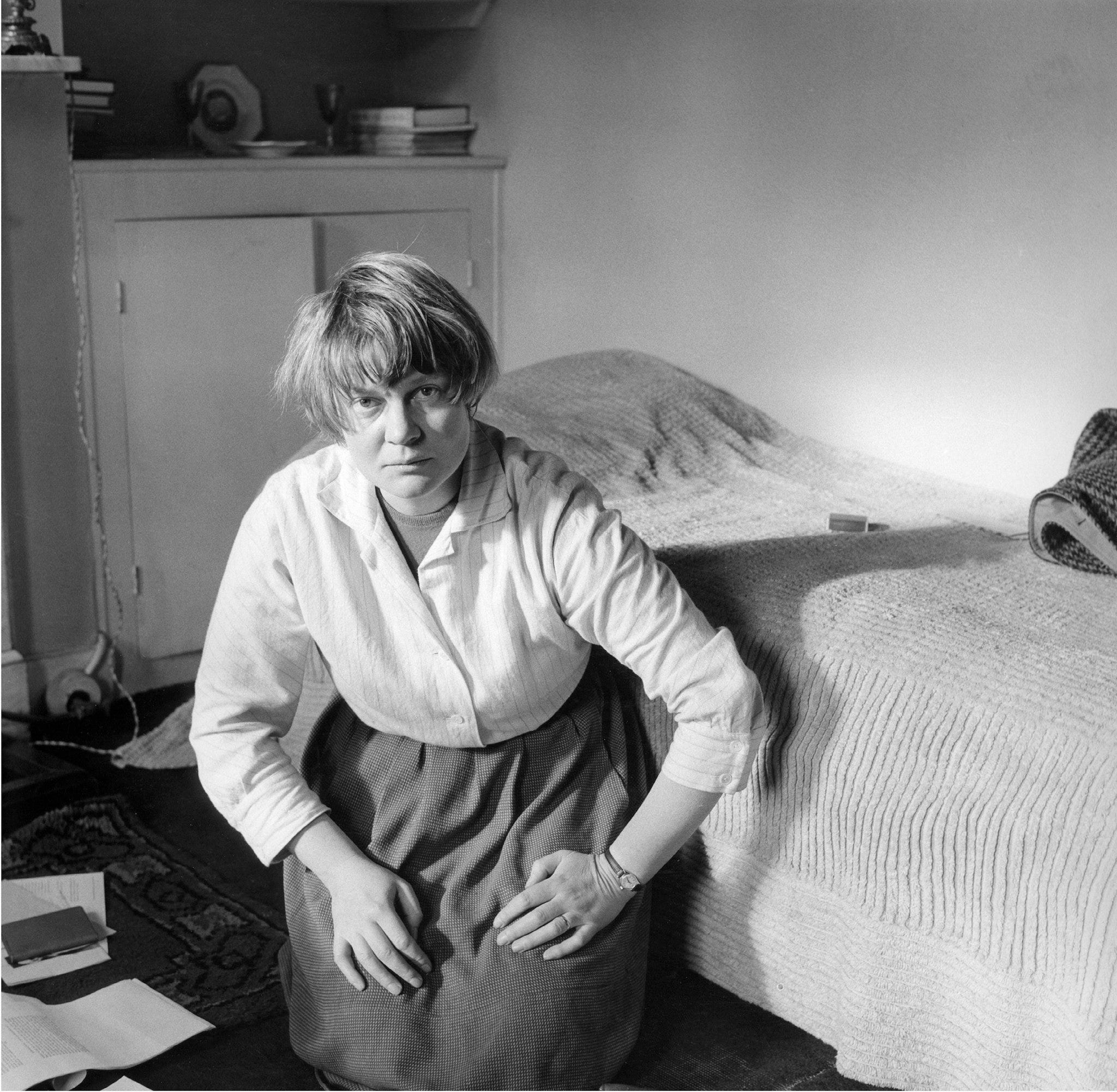
Iris Murdoch wrote many, many books – both novels and works of philosophy – and I would be surprised to find that this question isn’t addressed somewhere in all that writing. I’m wading into Metaphysics as a Guide to Morals – another 500 pages, this one about Plato, Kant, Wittgenstein, Schopenhauer, etc. and et. al. – right now, and would be surprised if, by the time I finish, I don’t have a clearer idea of how Murdoch justified novelism to herself.
Yet as intelligent and well-argued as Murdoch’s defense of fiction must be, I sense it will not be enough for my needs. Murdoch celebrated novels for their ambiguity, contra philosophy’s need of clarity, and part of what this ambiguity allows for is the personal development of a reader completely independent of that of the author (of course, this may be seen as yet another danger posed by fiction: that to a degree it invites hermeneutic corruption and misapprehension). I look forward to figuring out how Murdoch solved the problem of fiction for herself, but that does not undo the value, and perhaps the necessity, of my own attempt at understanding this problem. It has bothered me long before reading this book, such that, by having encountered it freely (The Sea, The Sea was a Christmas present from my sister, it was not something I had “expected” to read) I get the sense of fate knocking at the walls of my skull, furiously snapping its fingers in a hurried gesture. It should be interesting to make a response.
Firstly, the routes I must not take: decadence or aestheticism, which is a neutering of both art and life, confining everything that is actually interesting about existence (the love and jealousy implied in Truffaut’s famous “girl and a gun” aphorism) to a light-pink jelly. Saying of the immorality of fiction that “it simply does not matter” and that verbal fireworks are an end in themself provides a brief, daredevil thrill… and then nothing more, a hollow sky. I can find no lasting value in that, certainly nothing hardy enough to weather the often distressing nature of the creative act.
I reject style alone, but it still has something to do with my answer. Here, I want to look back to Kobayashi Hideo’s literal etymological definition of expression – the inner material which may only exit into the outer world once it has been worked upon by a great force, a kind of pressure. Ever since encountering Kobayashi last year I have been enamored with this account, its versatility (it seems to explain Proust as well as Dostoevsky as well as Austen), its obviousness, and its commonality. What ‘pressure’ refers to is not clear, however, and this missing piece has prevented me from making use of the idea of style-as-expression in the way that I would like. Is it a merely biographical pressure? In that case it would be difficult to say much of depth about the style of unknown contemporary or anonymous writers, and, what is more relevant to my discussion here, would do little to justify fictive art. A system of pressure is needed in order for the esoteric elements of Kobayashi’s account to touch reality – in other words, a special definition of pressure is necessary in order to make Kobayashi’s expression communicative, to push it into the realm of active criticism. In writing about Murdoch I cannot help but make mention of her rigorousness and her relentlessness – something I could otherwise refer to as a sense of pressure. At every turn her writing is informed not only by the free play of the imagination, but also by a pressure exerted upon herself by her own commitment to difficulty for her characters and, by extension, for herself as writer.
Can difficulty justify fiction? To an extent it may. Difficulty, I want to say, is always moral, is always a test of values. By playing a game which I find difficult I may develop humility as well as courage, and the most difficult of games can only be won by a real accomplishment, one which is not only physical or technical but moral as well. It involves becoming someone else, namely someone who can play this game. Doing work which I find to be difficult may bring the same benefits. How is so for the writing and, more importantly, the reading of fiction? There is difficulty in the composition of great art, and my own experience as well as accounts of others’ experiences leads me to believe that while any art can be easily passed over (we can refuse to engage with a movie on at the dentist’s office), the meaningful and transformative experience of art also involves a kind of difficulty. There were many dull days reading Proust front-to-back that my commitment bored me, but in reflecting on my experience I don’t believe I can say that my boredom was brought about by some misunderstanding on my part or by a lack of artistry on Proust’s. I want to say: I have been transformed by the difficulty of Proust’s commitment to his novelistic project, and I am capable of seeing that which I could not see before, something which has been revealed by the entire form of the work and my effort to engage that form, that entirety. At first I was accustomed to a different, aesthetic kind of reading. Now I have passed through or maybe even overcome my prior aesthetic sense through a change which is primarily aesthetic itself (I appreciate a new kind of lengthiness, an extreme discursiveness, to which I wasn’t responsive before) but which requires the activation of moral patience, attention, and humility.
I feel it does not matter that I spent a great deal of time reading about bad people such as Charlus, Mme Verdurin, and Odette, because in doing so I was aware of some deeper value in the novel which pushed me on through their terribleness and their boredom (this in and of itself is a skill of not inestimable value). Rather than being corrupted by them, I learned to look past them into the real action of the novel, the action of Proust’s commitment (made bare in Le Temps retrouvé) pressing like an olive press against his own moral center and creating the novel. I feel similar things could be said of any great novelist, whilst minor novelists adhere to their work with lesser difficulty, and bad novelists distract from or otherwise hide their moral centers from any sort of pressure.
Very well – I feel I have dealt with Plato’s criticisms regarding the presentation of “bad men”. But the most damning of his indictments, and I think Murdoch is in accord with me here, is the charge that art and literature can make us feel we are better than we actually are. I have claimed that there is a kind of residual moral action involved in reading and appreciating literature; what relation can this residual action have to fundamental goodness?
Here I am afraid I cannot refrain from making concessions to Plato. It is absolutely true that many people feel they are better than they actually are because of the contentment of art. I am not sure whether there is any difference in finding this contentment in Moby Dick as opposed to Coleen Hoover – good taste has only a minor role in a relative kind of goodness, and no role in goodness writ large (which is the only worthy kind). There are reactions to cultural philistinism which can do no better but to erect a moral philistinism in its place. In all likelihood reading literature should not constitute one’s primary, secondary, or even tertiary means of moral improvement or expression. As someone who spends a great deal of his time reading and writing about books, I am haunted, whenever I make a moral failing, by the thought that I could have been a little better if I spent my time doing something else. The moral actions I have been most proud of have occurred during periods of my life when literature seemed to fade, and the world was filled with an immediacy and brightness which outshone anything in books.
Such are my concessions. But I will not concede that ambiguity of which Murdoch was so fond and which I’ve taken as licence for this little adventure in philosophy. By inviting ambiguity there is, true, the potential for snobbishness and self-satisfaction to arise. But insofar as we move through a world which ought to be permanently ambiguous, and yet which often settles into rhythms of dull objectivity, there is perhaps a chance – I cannot say how large or small, only that there is a chance – of the ambiguity of art leading us back to the ambiguity of our own lives, of the arbitrariness of stories leading us to an awareness of the arbitrary views we hold regarding our own lives and which block us from being deeply receptive to truth. Literature is never a final product, but always a practice.
Charles’ cousin James – an otherworldly Buddhist who often calls attention to Charles’ failings – chides him over his professed love of Hartley, saying, “you’ve made it into a story, and stories are false.” James, at another point, offers Charles a mystic’s point of view: “If even a dog’s tooth is truly worshipped it glows with light. [...] if there is art enough a lie can enlighten us as well as the truth. What is the truth anyway, that truth? As we know ourselves we are fake objects, fakes, bundles of illusions. Can you determine exactly what you felt or thought or did?” I want to posit two kinds of fiction, that which is merely a story, and that which is merely a dog’s tooth. Fiction, it seems to me, is a mere thing. Art is a mere practice amongst others. It undeniably possesses the potential for worldliness, being a human creation. It may turn out as nothing more than a story created to praise an unrefined and over-sensitive ego. Or it may turn out as a dog’s tooth: hard, pointed at one end, covered in the slime of reality. There are those who are hard set on worshipping it until it glows. The better route, perhaps, is to gaze at this tooth only long enough to spot its glinting edge, and then to turn, and to find opposite the dog a real source of light.
Love Murdoch but haven't read The Sea The Sea yet. Bookmarking this!
The Flight From the Enchanter is the Murdoch book that changed my life, maybe because it's feminist in a way the others, having bigger fish to fry, aren't. It's also probably not a complete lie.