
In-no-sense
What am I reading, anyway?

Is there any way to reconcile literature, and birdsong?
While on a recent trip to LA I visited a Taschen store, a little hut in an outdoor shopping center, and bought a copy of the book Jazz Covers. The inside flap of the book says it “assembles the most daring and dynamic jazz cover designs that helped make and shape not only a musical genre but also a particular way of experiencing life.”
On page 201, across from a picture of Dizzy Gilespie wearing traditional Greek costume, is the cover of Enfin! by Jef Gilson, which was released in 1962 by the label CED. The title is written on the cover in large block letters, beneath which a tasteful serif font reveals Jef’s name, and below that, in smaller type, there are the very French names of his collaborators: Jean-Louis Chautemps, François Jeanneau, Jean-Luc Ponty, and Bernard Vitet. Below these names is a black-and-white photo of Gilson posed behind the raised lid of his piano so that it obscures his face at an angle cutting from chin to jaw. The blurb beneath informs the reader that the photographer, Jean-Pierre Leloir, “has photographed many of the world’s musical icons, from Billie Holiday to Jimi Hendri,” – an unknown musician who I can only suppose to be, in fact, a slandered Jimi Hendrix.
I looked up Enfin!, which I had never heard of before finding it in Jazz Covers, on Apple Music. The title and Gilson’s name were the same on the app, but the cover depicting Gilson’s face has been replaced with crude stick-drawings probably meant to depict the members of the quintet. The look of this pianoman, which at one point was worthy of attracting the same cameraman as Billie Holliday and Jimi Hendri(x), has been shuttled off to the archives, and what now stands for his music is not himself nor any of his fellow musicians, but the kind of art-ish illustration one can find on any number of European jazz records. For the modern listener, Jef Gilson’s Enfin!, despite its musical charm (and it is quite a nice album, especially for this time of year), will be visually represented in a style that conveys only a lack of inspiration.
But the original cover of Enfin! is not wholly lost, not quite. Jazz Covers describes this recording as “an extreme rarity”, and it indeed appears to be just that, the five vinyl LPs of Enfin! for sale on Discogs range from $117 to $300. But if that price is a little too steep, one can always go to the Taschen store in one of LA’s many shopping centers and, for a more reasonable $30, buy a two-inch-by-two-inch picture of it on page 201 of Jazz Covers.
And something else: there is no reason to waste $300 on an original vinyl edition of this album. I have to inform you that Enfin! is just as good – just as French, just as 60’s, just as summery and light – with or without Jef Gilson’s face. The digital cover is quite poor, it wins whatever hate I can spare for it, but it doesn’t touch the music. And there may even be some benefit to the new cover’s total lack of personality – the music is free and unassociated, ready to mix with the listener, as it were; it is human, one can still pick up on all the recording details that make albums from this era so tactile and close, but it has an anonymous sort of humanity. Jef Gilson and his band are required for the music – and then nothing more.


Over the last few months I have read or reread all of Jane Austen’s finished novels, from Northanger Abbey to Persuasion; I have lost track of the lines distinguishing one work from the next; and at the end I wonder whether I know a person named ‘Jane Austen’...
A silhouette comes to mind almost immediately. She is reclining in a chair, wearing a regency dress and a bonnet; she is witty but reserved. Virginia Woolf wrote about her, Somerset Maugham wrote about her, C. S. Lewis wrote about her. Probably hundreds, if not thousands, have written about her. Hollywood has made movies about her. She could dispense with a bore at the drop of a hat, and after no more than a passing glance make a match between two young people that would never be second-guessed. Yes, that’s Jane Austen: lightly mythologized but altogether plausible. Even if her sister burned all the letters, her nephew wrote that book.
But primarily it is not the nephew’s memoir that we remember her for. We remember Jane Austen for her writing. It is only a matter of course that we should think her writing is, in a way, her self, and that she lives on through her work. But then I look to her novels once more and I cannot find a single line, paragraph, or passage which leads me to her. Everything is about the characters; ‘Jane’, as the people call her, is absent. I begin to doubt. If she is not in her books, and if most of what we know about her character comes secondhand, then where is she?
That there are points of overlap between her biography and her work I understand well enough. I look at pictures of the places she lived. I look at recreations of dresses. I read long, boring introductions to her novels that explain the mores of her world, its economics and its politics. Yet I read Emma and cannot, simply cannot, break through the words and arrive at a person. Without presupposing her presence, Jane Austen is nowhere to be found.
The words are not inhuman, the words are alive. But they are not alive as a person is alive – they are alive in their own way. They bear the imprint of an author’s personality but they are not the author themselves; written by another person these words would carry the same wit, irony, and innocence. They are a form of life unto themselves. Their beauty is not entirely human.
“...those who, despite being of flesh and blood, have internally crossed a boundary equivalent to death, receive on the other side another life, which is not primarily life, but which is primarily truth; truth become living. True like death and living like life. A life, in the words of Grimm’s fairy tale, as white as snow and red as blood.” – Simone Weil, The Need for Roots
The author is not dead; the author is not fully present, either. From a work we translate an author, and as is the case with all translations of a single source, there is a point beyond which the term ‘accuracy’ refers to something more akin to taste than linguistic truth. Just as there is no perfect translation, there is no perfectly rendered authorial self. There is no singular or objective Jane Austen who can be lifted from her works. Those who look to literature for immortality in fame and greatness will only find once again the dissolution of the ego into various incongruent strands.
Here: John Berryman’s Dreamsongs are surely his work, we think, they are a kind of confessional poetry, they belong to that school – Robert Lowell, Sylvia Plath, etc. – of American poets whose great subject was themselves.
But can I say the Dreamsongs are themselves John Berryman? Or are they a dying alcoholic and serial adulterer – any dying alcoholic and serial adulterer?
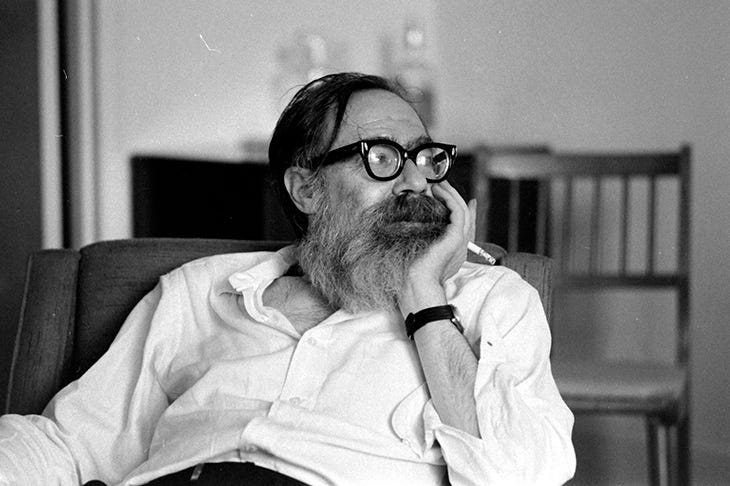
Baudelaire: n’importe ou hors du monde. He believed – and Proust believed after him – in the work of literature as a work of entombment. After Baudelaire and Proust this belief has become a matter of fact. But neither Baudelaire nor Proust believed perfectly in literature as a memoir éternel. Baudelaire killed himself with drugs, Proust’s hypochondria made him a hermit. It is perhaps only the case that one can pass into writing if one performs a sort of self-sacrifice – this life for the next. The ghost passing from the shell of the flesh to the shell of the word. Pain.
Yeats: Perfection of the life, or perfection of the art. One can have neither. Survival in life, or survival in art…
Mamoru Oshii’s Ghost in the Shell films are perhaps most widely regarded as odes to a ‘wouldn’t-it-be-cool-if’ cybernetic future, the kind of thing which apparently used to be fun to dream about in the 90’s when these films were released but which, in the decades since, has been co-opted by Silicon Valley. A book-length essay on the Ghost in the Shell franchise published in Japan proclaims on its commercial obi that this series is “beloved by Elon Musk”, and whether that’s meant to be a good thing or simply a neutral evaluation of billionaire aesthetics in the 21st century is unclear. It is somewhat more difficult to watch these films as examples of pure cool when, during the first film’s iconic ‘birth of a cyborg’ opening credits sequence, visions of Alex Karp intrude.
But it’s always a blessing, when historical circumstances chip at a style and reveal something else beneath. Having become technologically pessimistic – with qualifiers, mind you – I now think Oshii’s Ghost in the Shell has little, almost nothing, to do with technology, and everything to do with a kind of mysticism. These films oscillate between sci-fi action and Platonic dialogue; the perspective is always philosophical, the camera captures violence and portrays artistic passion but digs up no individual human emotions. In a way Oshii’s work (not just Ghost in the Shell) reminds me of 2001: A Space Odyssey. His protagonist is the human soul.
But unlike Kubrick in 2001, Oshii does not seek to guide humankind to a new place among the stars – he has no romantic and vaguely terrifying vision of a man as large as Jupiter. The first Ghost in the Shell film concludes with its protagonist, special forces cop Major Motoko Kusanagi, uploading her consciousness to the “vast and infinite” net and living as a new sort of being, unattached to any particular body. She describes her transformation as a new kind of freedom, but to her partner, Batou, what she has done is nothing short of suicide.
Oshii’s Ghost in the Shell 2: Innocence is more of a coda than a direct sequel; its star is Batou, who continues to try and make sense of the Major’s ‘disappearance’ into this supposedly new form of humanity but can only conclude she has died. The Major insists on a form of transcendence Batou finds it impossible to celebrate, let along understand. While the original Ghost in the Shell presents Oshii’s bold and Buddhistic vision of a life beyond the bounded ego, Innocence dissects and represents the vanishing self.
Much of Innocence’s script is made up of quotations, with sources ranging from Milton and La Rochefoucauld to Buddhist scripture. In an interview Oshii stated he would have liked to compose the film’s script entirely out of quotations. In a world full of robots and AI and surveillance – that is to say, the world of Ghost in the Shell as well as our own reality – whatever can be said has already been said. Communication fills the world, the map blankets the territory from end to end. What still refuses to be said – what is eluded to, perhaps, in Innocence’s hypnotic parade sequence – reminds us of our own imperfection and the need for something more than natural life, be that through technological or mystical means. And what is mysticism if not the thinking of technology – and particularly of good, humane inventing – applied to the soul?
There is something else about Oshii’s films, exemplified in his use of quotations throughout Innocence, which could be noted – and that is his own selflessness. His filmmaking is like Jane Austen’s writing, borrowing much from old masters. Ozu and Tarkovsky come to mind in the way he allows his camera to linger and in his love of silence. Like Austen, he does not want to be in the film. And like Austen, he has a sense of irony which extends deep into the heart of the matter. He makes his films out of the same stuff which they are about. Innocence merges comfortably well-done digital animation with uncanny valley CGI; it places Oshii’s own philosophical dialogue alongside Descartes; it wears a cyberpunk skin but has bones made of the oldest wisdom, stranger than any future we may stumble upon or fling ourselves into. Ultimately the difference between the mind of Oshii and the mind of Musk is this: the former can, in the midst of creation, perceive his own nonexistence. The latter would never think to try.
Mozart, Austen, Ozu, Tarkovsky, Oshii, Bashō, Coltrane, Takeuchi, Whistler, Bonnefoy…
All names of varying recognition, but each, to me, calls up a set of art and almost no personal qualities… and their work, which has settled so deeply in my senses and in my thoughts, at times breaks into my mind like a strain of natural music…


“In a place where there is something that can be distinguished by signs, in that place there is deception. If you can see the signless nature of signs, then you can see the Tathagata.” – The Diamond Sutra
It is not so far a distance from natural music to human music. Perhaps this is evidence of a shared animal instinct; perhaps it is yet another instance of art copying nature. And perhaps, as Rilke says, we must sing things into being, and all that is, is music.
From birdsong to language and literature, though, seems to be more of a challenge. Birdsong may be an elementary form of communication, but from what we can tell – outsiders looking in – it is broadly a network of signals, with many beautiful but non-communicative frills. Language is much stranger than this. Language is like a bridge hanging in the air, connected at no point, upon which everyone comes and goes nowhere. It is the metropolis of the imagination. When mapped onto the rhythms of poetry, language borrows from music. But prose has its own, not-quite musical rhythms; and the focus is almost never on the rhythm. When Austen tells us that a young woman is “handsome, clever, rich” or that she will reform herself to “regular, kindly, equal intercourse”, we understand her to mean something more concrete than Mozart or Jef Gilson or a sparrow ‘mean’ (do they mean anything?).
But perhaps it is a mistake to use the second-person plural here. Do ‘we’ understand her to mean the same thing? How could we even know? Wittgenstein posed the problem of common meaning in language as ‘feeling toothache in another person’s tooth’. The only way I can understand if another person has toothache is if they tell me, either in words or through gestures. I do not feel the pain myself, though. I do not know what their pain is, only that there is some pain. And so, if I join one of the many Austen fan clubs spread across the globe, and have a discussion with them about the opening line of Emma, we may for hours discuss the meaning of those three adjectives, but may never know with certainty that we understand them to mean the same thing.
Wittgenstein’s problem has Wittgenstein’s solution, of course. Familienähnlichkeit – the family resemblance – is where the problem comes to rest. We cannot know that we understand a word to mean the same thing, but we can be confident enough that we both understand it to mean close to the same thing, that there is no more difference between my understanding and the next person’s than there is between the faces of two brothers.
Looking back to music – isn’t it exactly the same? Isn’t there a broad universality to certain melodies and harmonies, which are understood to be melancholic or celebratory mostly anywhere in the world, yet which are melancholic or celebratory to certain people in different ways? The form of music differs obviously from that of literature. But they resonate in the same darkly present center of our understanding. If this is the case, then a reader excavates just as much meaning from a work as they must also excavate from themselves.
My favorite Jane Austen novel is Emma; in that book you can find an author turning themselves inside out. Emma is the very moment (a 446-page-long moment, in my edition) at which Jane Austen begins to work out an understanding of the source of her talents and the source of her creative passion. Before Emma, Austen’s novels are like Mozart’s childhood symphonies: beautiful in and for their innocence. The ironies of the earlier works, rich as they are, begin and end within their pages, because the earlier works are subject to the very innocent misbelief that a novel must be something; the earlier works do not realize how a novel simply is. Similarly, Emma and its epilogue Persuasion embody true artistic greatness in the same way that Mozart’s mature symphonies do: rather than losing innocence and growing in cynicism, they find innocence beyond their author, find innocence within the world, pervasive in it. Emma and Persuasion have learned and forgotten how to be novels before they even reach the mind of their readers; they are in every level of their construction stories in which one learns to forget what one has learned; they are stories of deep misapprehension; they are the end of identity.
Let’s consider Emma more closely. In terms of written style it is not really discernible from Austen’s other novels. Her love of Johnsonian syntax persists and her moral vocabulary is impeccable and varied. The heroine – Emma Woodhouse, described in the famous opening line as “handsome, clever, rich” – does not differ so greatly from Austen’s previous stars (though she does appear to be the most well-off of the bunch). Gradually, however, the perspective shifts from what we are accustomed to in a book like Pride and Prejudice. The previous heroines have all had to reckon with their misjudgments and amend their ignorance, but none have been so fundamentally ignorant, so wholly unwise as Emma Woodhouse. Because of this expectation, a first-time reader may well misinterpret Emma’s imperfections as simply more romantic-comedic capering. Her manipulation of Harriet Smith – splitting her up from Robert Martin and then attempting to make a match for her with Mr. Eliot – strikes the reader as at first being one more instance of Austen wedding reason to love. Surely, the reader thinks, it would be better for Ms. Smith to be with the rich and charming Mr. Eliot than the poor and uneducated Robert Martin? When it comes to marriage, money really does matter. Such is at least part of the point of Sense & Sensibility, part of the fantasy in Northanger Abbey, that one can have both romantic and financial assurance in marriage. But somewhere along the way the reader grows in discomfort with Emma’s behavior. Ms. Smith ought to be with Robert Martin, regardless of his education, and Emma was wrong from the first to believe that Mr. Eliot cared for her friend; yet Emma shirks her responsibility, refuses to own up to her manipulation. Some readers never recover from the realization that Emma, unlike Marianne Dashwood or Fanny Price, is not at bottom a good person (Somerset Maugham in his essay on Austen writes that Emma’s persistent unlikeability throughout much of the book sinks the whole novel).
There are two easily discernible layers of irony that run throughout Emma. One of these is found in Emma Woodhouse’s inability to see herself accurately, to which is added her stubborn antagonization of Mr. Knightley, the only person who offers her a mirror; the other is to be found in the fact that Jane Austen, a writer to this day best famed as a sort of matchmaker, is engaging in self-critique through her romantically scheming main character. But these ‘layers’ of irony should not be understood to mean something like the layers of a cake, easily discerned from a critical sideways glance. Austen layers her irony like geologic aeons layered across the Earth; and similarly there is no way of directly viewing the center. The pressure of it all packs the novel down to the point of impenetrability. There is a dimension to Austen which we can sense and which, like the center of the Earth, we conclude must exist, but no one goes there, and no one can. The irony in Emma is not only comprised of Emma Woodhouse’s vanity and Jane Austen’s meta-critique, but is a deep foundation, a stabilising crystal, and an inmost mystery.
What happens to Emma Woodhouse when she realizes the magnitude of her mistakes dips momentarily beyond our vision into that hardened depth. The terrible moment is presented in the well-measured, neither maximal nor minimal style of Austen. It is the first paragraph of Chapter 44, which summarizes how Emma spends the rest of the day after being seen off of Box Hill by Mr. Knightley:
“The wretchedness of a scheme to Box Hill was in Emma’s thoughts all the evening. How it might be considered by the rest of the party, she could not tell. They, in their different homes, and their different ways, might be looking back on it with pleasure; but in her view it was a morning more completely misspent, more totally bare of rational satisfaction at the time, and more to be abhorred in recollection, than any she had ever passed. A whole evening of back-gammon with her father, was felicity to it. There, indeed, lay real pleasure, for there she was giving up the sweetest hours of the twenty-four to his comfort; and feeling that, unmerited as might be the degree of his fond affection and confiding esteem, she could not, in her general conduct, be open to any severe reproach. As a daughter, she hoped she was not without a heart. She hoped no one could have said to her, “How could you be so unfeeling to your father?—I must, I will tell you truths while I can.” Miss Bates should never again—no, never! If attention, in future, could do away the past, she might hope to be forgiven. She had been often remiss, her conscience told her so; remiss, perhaps, more in thought than fact; scornful, ungracious. But it should be so no more. In the warmth of true contrition, she would call upon her the very next morning, and it should be the beginning, on her side, of a regular, equal, kindly intercourse.”
Jane Austen never implemented free indirect speech so well as she does in this single paragraph. She opens with a brief reflection on the drama at Box Hill, when Emma openly insults Miss Bates. Then regret begins to recede into comfort, as the benefits of an evening spent with Emma’s father are considered. But Emma’s thoughts cannot stray from Box Hill, Miss Bates, and Mr. Knightley for long. The quotation towards the end – “How could you be so unfeeling to your father?” – is a direct parody of Mr. Knightley’s rebuke of Emma from earlier in the day, the one that led her to realizing her own cruelty. As the narrator has taken on Emma’s voice they have taken on Mr. Knightley’s as well, again creating layers and increasing what I would call the ‘knowing opacity’ of the moment (we are able to follow Emma’s state of being with clarity, but our ability to follow both the emotion and the logic of the sequence is impeded, and even while logic continues, it is only emotion we are aware of now). The aborted sentence that follows the quotation, the gasping “Miss Bates should never again – no, never!” drives home the extent of Emma’s altered perspective. Emma Woodhouse, handsome, clever, rich, would never allow her thoughts to stray into that zone of intensity where they disappear and become pure regret and contrition; but she is no longer that first Emma. The sentence following this one takes the reader into a philosophical region, pondering what the proper repentance for Emma’s wrongdoing could be and casting the question in terms of time, of the guilty past and the innocent future. Then comes a little of the classic Austenian moral dissection. Finally, there are two sentences, homiletic almost, not so frequent in Austen’s writing, but by no means outside the bounds of Austen’s life (she was, after all, a preacher’s daughter): “But it should be so no more. In the warmth of true contrition she would call upon her the very next morning, and it should be the beginning, on her side, of a regular, equal, kindly intercourse.” And so we see that lesser instances of resurrection need not take a full three days.
Emma’s awakening to a fuller perspective of herself and her surroundings happens in response to a level of moral corruption which Austen’s previous novels do not deal in. The kind of “growing up” experienced by Fanny Price, Catherine Morland, and the Dashwood sisters seems in a way only natural. By this I mean that by the end of their respective novels, these heroines have matured into adult members of society. They were never really bad, merely uninformed, impulsive, and altogether adolescent. Yet Emma is already an adult when her story begins, having seen off the woman who raised her. She lives alone with her either eccentric or half-senile father, and operates much of the goings-on in the house in addition to taking on a sisterly role in regards to Harriet Smith. Emma is of an age and a situation to know better, but she does not. Her ignorance has gone on too long, its lifespan has been extended willfully. What happens towards the end of the novel is not really a maturation so much as it is a transformation. The scope of Austen’s settings are pastoral and quiet, but with Emma, she found that the other dimension of a novel, its characters, contained room enough for an epic.
Reading Emma, I want to say that there are two ingredients necessary for the new innocence characterizing a great novel: a form of irony so deep it becomes a singular, but invisible, principle; and a talent willing to commit itself to only the fullest form of psychology attainable.
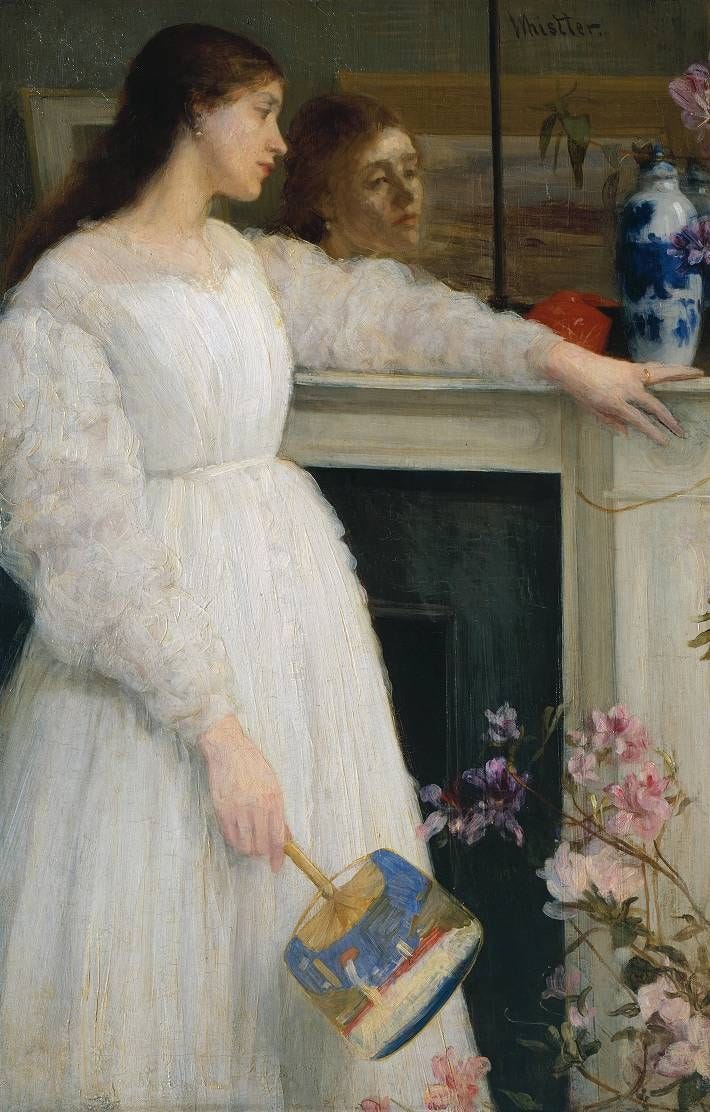
Consider, not the death of the author, not their continuance through literature, but rather a kind of apotheosis, an upwards transformation, or rather an infinite process of transformation.
Consider the work itself, consider it skeptically, do not go ghost-hunting.
Consider how, before the sound of birdsong, the barren scalp of the Earth shook with the sound of waves throwing themselves against moon-rocks… disappearing… dwindling… fading…
Yes to all this. My first time reading Emma, I was as shocked by Emma’s transformation as she was. Did not see it coming. Masterful writing by Jane Austen. It’s the one book I’d like to read again for the first time.