

The great difficulty I have faced in trying to write about life in Japan is that there is simply too much to think about. Giving myself an hour to write before dinner in the evenings, I open a document, carefully type a paragraph about some particularity of the experience, then erase it and begin again. After the hour is up, I have to take myself away from the desk for the night; the alternative is forgetting to eat and continuing to fail, failing better as Samuel Beckett really meant it, that is to say, creeping towards an ever-clearer outline of the goal but never fulfilling it. Knowing what I cannot (at least for now) complete – the totality of this experience.
Which was the whole idea. Life in America was too simple, or rather, it appeared to be so. I felt the subtleties of life, wherein lay the opportunity for progress, were clouded out by false familiarities that no mental effort could overcome. Everything and everyone I saw was too easily sorted. I began to lose the knack for particularity, which is what I want in my writing more than anything else. I knew what held meaning, but explaining or deepening these feelings of importance seemed to be futile. I thought I knew everything; at the same time I understood that this was impossible. What was needed was a pilgrimage to a place outside my own head. The other side of the world offered itself as the solution, and I accepted gladly.
Over the past months I’ve tried to give experience priority over thought and writing. It is uncomfortable for me, I have to admit, not because I necessarily prefer to spend all day at my desk drafting and erasing, drafting and erasing; but because whenever I am not writing nor thinking about what I will eventually write, I accuse myself of failing to meet a moral obligation. For a long while I’ve been able to recognize this as a bad psychological hang-up, part of a matrix of false identifiers I referred to as the ‘persona’ in one of my earlier essays on Hideaki Anno. I want out of the human condition, so I opt for the writerly condition and foment writerly anxiety. It’s all a little fake, has a fluoride taste about it. “Every man carries the form of the human condition within himself,” wrote Montaigne. Yes, and he stows it away eagerly into these cumbersome self-stereotypes.
Eventually I would like to write about Japan. I assume it will only be possible, however, once I know what it really means to need to write, and not to do it out of an egotistic obligation.
In the meantime, I’ve been trying to think of whatever I do write as not being such. Instead I prefer to ‘paint’ scenes. I try to silence all narration and focus only on the objects within the field of imagination I want to transfer onto the paper. It does remind me somewhat of the book of Japanese death poems I read during my last year in college. As the sometimes nameless author diffused out of reality and on to his next reincarnation, in those poems he picked a handful of stock phrases and seasonal imagery from the kigo lexicon and strung them at the top of the page like leaves along a branch. I try to make my way through a page with just as much care for the arrangement of the words. Now, I abstain from deep meaning. Because maybe a monk, in a period of heavy fasting, learns more about food than hunger.
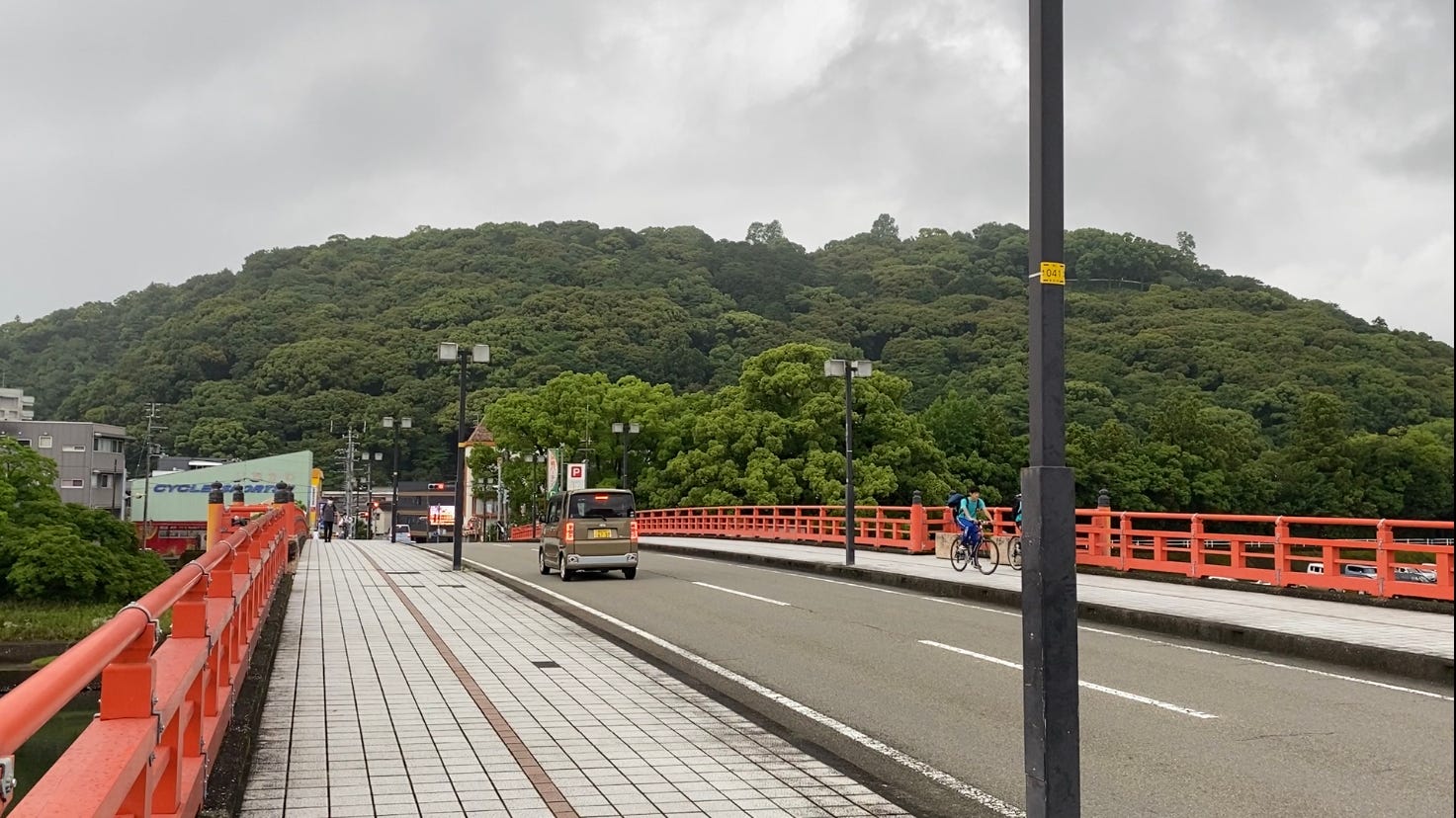
Yesterday after dinner I stopped along Kumagawa – Bear River – and looked into the water for a while. The riverwalls, the sky, and the motionless water were each forms of the same inky black. Clouds covered the stars above. When fish rose to kiss away an insect from the roof of the river, white rings drove out from the point of contact, fainted and disappeared as their radius overextended, collapsed. It had been a hot day, and the night was still a little warm. A few cars drove past me, and some bikers, and joggers. The clap of skateboards echoed from the park behind me. Further out, lighted apartments and empty shops. Further still, the humpback mountains, whose trees, too, turn black at night.
I’ve been feeling a similar thing. I’ve had a somewhat awful experience coming to realize that I always want to turn a presenting of particulars into a system of concepts. Every time I write something for Substack I ask myself if it’s grounded in real human experience rather than just an egoistic obligation to write or to express an Idea I Had and then I delete it. You put the feeling much better than I could’ve, Alma’s right to say that this particular piece was beautiful.
I actually had a really good conversation with Ed about this when he was home for the wedding, about how I think a lot of the issues I had in hs came from that concepts come before experience for me. Christopher Nolan-izing film is probably the most egregious form of that. Those films are more so symbols for ideas than an actual presentation of the particularity of some problem. If I wrote a story it’d probably become that. That’s a reason why I’ve been focusing on history, it’s the non-fictional form of writing that forces me to do that.